SEO for Restaurants in 2026: Leverage the Mexico vs. Ecuador Match to Attract Customers
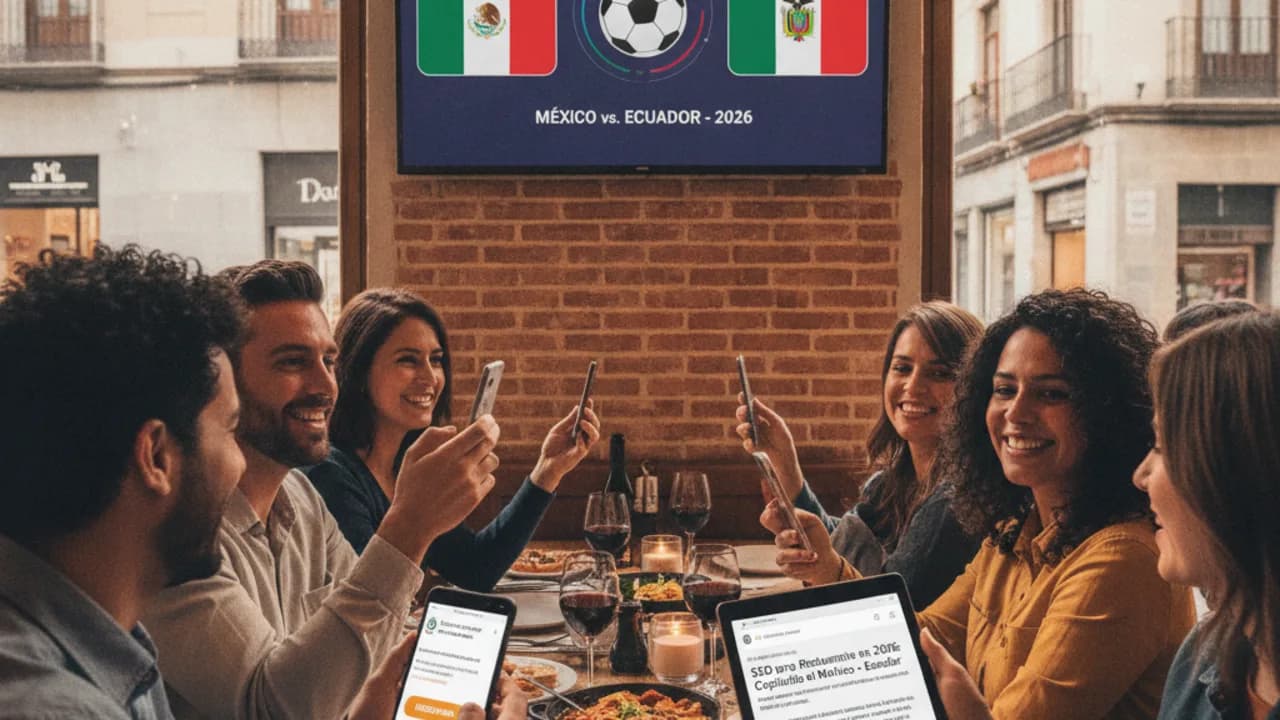
SEO for Restaurants in 2026: Take Advantage of the Mexico - Ecuador Match to Attract Customers
Did you know that only three restaurants capture most of the local searches on Google? According to Avantys Academy (2026), the Local Pack shows only 3 results, making that block the most competitive —and profitable— territory for SEO for restaurants [3]. If your business doesn't appear there, you're practically invisible to those searching for where to eat nearby. And when a high-impact soccer match like Mexico vs. Ecuador approaches, the demand for reservations and online orders skyrockets: exactly the moment you need to be in the top position.
I remember once when a similar match was played, and we decided to create a special event at our restaurant. Not only did the place fill up, but we also received a large number of positive reviews in the following days. Including unique promotions for that day can really make a difference.
Why the Mexico - Ecuador Match is a Real SEO Opportunity
Sports events generate very specific search spikes: "where to watch the Mexico Ecuador match", "restaurants with big screens near me", "order food to watch the match". These are searches with high purchase intent and a short time window, making them perfect for a well-positioned restaurant.
The key is not to modify your entire strategy, but to capture that temporary traffic with specific and low-cost actions. A post on your blog, an update on your Google Business Profile, and a few well-chosen photos can make the difference between being in the Top 3 or not existing for those customers.
Moreover, the content generated around the event continues to attract traffic weeks later, especially if your restaurant posts consistently. Tools like RankCoworker allow you to schedule monthly articles on seasonal topics —including sports events— without needing to know anything about SEO or dedicating hours to it.
What Specific Searches You Should Target
- "Restaurant to watch the Mexico Ecuador match [your city]" — high conversion local search.
- "Special menu for the Mexico match" — ideal for themed promotions.
- "Order food to watch soccer [your neighborhood]" — capture home delivery orders.
- "Bar with big screen near me" — enhance your differentiation if you have that service.
- "Reserve table for the Mexico Ecuador match" — connect with those who are already deciding where to go.
The Three Pillars of SEO for Restaurants You Can't Ignore
According to DoorDash Merchants (2026), SEO for restaurants is organized into three fundamental pillars: local SEO, on-page SEO, and authority [4]. Working on just one of them is not enough; all three reinforce each other.
In our city, a well-known restaurant managed to stand out by offering a themed menu during a major sports event. Not only did they significantly increase their reservations, but they also improved their ranking on Google thanks to the additional traffic.
1. Local SEO: Your Google Business Profile as the Foundation
According to GastroSEO (2026), SEO for restaurants focuses on appearing in the Top 3 of the Google map, working on the business profile, reviews, a coherent website, and presence in local directories [1]. It is the mandatory starting point.
Joy Hawkins, a local SEO consultant at Sterling Sky, states in her 2026 analyses that profile completeness, relevance, and reviews are decisive signals for the visibility of local businesses. In other words: a half-finished profile is money left on the table.
According to SEOSTAR (2026), photos, menu, online reservations, updated hours, and active review management are the key elements to improve visibility and conversion on Google Maps [5]. Review each of these points before the match.
2. On-page SEO: Your Website as a Reservation Engine
According to Avantys Academy (2026), integrating reservations in Google, using the Restaurant schema, and keeping the menu in HTML text —not as an image— are practices that directly improve positioning and conversion [3].
A menu published as a PDF or image is invisible to Google. If your menu is in HTML text, search engines read each dish, price, and description, increasing your chances of appearing when someone searches for "nachos near me" or "tacos to watch the match".
3. Authority and Reviews: The Human Factor That Algorithms Value
Miriam Ellis, a local SEO expert at Search Engine Land, points out in her 2026 publications that recency, volume, and response to reviews influence user trust and local organic performance. It's not enough to have reviews; you must respond to them.
According to the study by Michael Luca (Harvard Business School, 2011), a one-star improvement in online rating can increase revenues for independent restaurants by between 5% and 9%. The impact of digital reputation on real sales has been documented for over a decade.
According to DoorDash Merchants (2026), responding to reviews is one of the most repeated factors in restaurant SEO guides this year, and it is directly related to local prominence [4].
Comparative Table: SEO Actions Before vs. During the Match
| Action | Before the Match (1-2 weeks) | During the Event |
|---|---|---|
| Google Business Profile | Update special hours, add themed photo, publish event news | Verify that the hours are correct and respond to messages quickly |
| Website / blog | Publish article "special menu for the Mexico-Ecuador match" with local keywords | Have a reservations or orders page clearly visible and functional |
| Reviews | Respond to all pending ones, ask recent customers for reviews | Invite attendees to leave a review after the event |
| Schema / structured data | Check that the Restaurant schema is active on the website | Verify that the reservation system works without errors |
| Photos | Upload photos of the space with a screen, atmosphere, special dishes | Upload photos of the event in real-time to Google and social media |
Visibility in AI: How to Appear When People Ask ChatGPT or Google AI
According to Puro Hospitality (2026), AI can already make reservations in some markets, and reviews influence both local ranking and selection by artificial intelligence systems [2]. This changes the game.
When someone asks an AI search engine, "Where can I watch the Mexico-Ecuador match in [city]?", the system cross-references information from your Google profile, your reviews, your website, and your published content. A restaurant with a complete profile, recent reviews, and a blog article on the topic is much more likely to be recommended.
According to TastyGrowth (2026), maintaining a steady flow of reviews, photos, and content is precisely what differentiates restaurants that appear in these results from those that do not [7]. Consistency wins.
Google indicates that local ranking is primarily based on relevance, distance, and prominence, according to the official Google Business Profile Help documentation. Of these three signals, prominence is the one you can most actively work on with content and reviews.
Quick Checklist: SEO for Restaurants Before the Match
- ✅ Complete Google Business Profile: hours, categories, photos, menu, and reservation link.
- ✅ Publish an article or post about the event (special menu, screen, atmosphere).
- ✅ Respond to all pending reviews before the week of the match.
- ✅ Add local keywords to the article: "[your city] + match + restaurant".
- ✅ Verify that the menu on your website is HTML text, not an image or PDF.
- ✅ Activate or review the Restaurant schema on your page.
- ✅ Publish new photos of the space on Google Maps.
- ✅ Schedule a post on Google Business Profile announcing the event.
Online Reputation: The Signal That Lasts the Longest
According to Rispia (2026), online reputation is directly related to visibility in the Local Pack, and review signals on Google Business Profile are a central part of local ranking [6]. It's not an extra: it's structure.
The week after the match is the best time to ask for reviews. Customers who had a good experience —atmosphere, food, service during the event— are highly likely to leave their opinion. A simple thank-you message with a direct link to your profile can generate five to ten reviews in a few days.
If you don't have time to manage this every month, services like RankCoworker can help you maintain a steady flow of content and visibility without needing to be an expert in digital marketing.
I believe that online reputation is as valuable as the best advertising campaigns. The reviews we have obtained after significant events have become our best calling card, attracting new customers looking for experiences already proven by others.
Frequently Asked Questions About SEO for Restaurants
How long does it take for SEO to work for a restaurant?
Changes in Google Business Profile —photos, hours, posts— can reflect in a few days. Organic positioning of the website usually takes between 4 and 12 weeks depending on local competition. For specific events, publishing content 10-15 days in advance maximizes the chances of ranking in time.
Do I need a professional website to do SEO for my restaurant?
You don't need a very elaborate website, but you do need one with the menu in HTML text, clear contact information, and a link for reservations or orders. Many restaurants rank well with simple websites as long as the Google profile is well managed. The essential thing is that the information is consistent between your website and your Google profile.
Do negative reviews harm my restaurant's SEO?
A negative review managed correctly —with a professional and constructive response— has much less negative impact than a negative review without a response. According to the analyses of Miriam Ellis (Search Engine Land, 2026), active review management influences user trust and local organic performance. Always responding, even briefly, is the best policy.
How can my restaurant appear in the results of ChatGPT or Google with AI?
Generative AI systems use public information: your Google profile, your reviews, your website, and the content you publish. A complete profile, recent reviews, and relevant blog articles are the signals that these systems read to recommend local businesses. According to Puro Hospitality (2026), reviews already influence AI selection in some markets [2].
Conclusion: Act Before the Match Starts
SEO for restaurants is not a long-term strategy reserved for large chains. Any local business can improve its visibility on Google and AI search engines by taking concrete actions: completing the profile, publishing relevant content, managing reviews, and leveraging the interest generated by events like the Mexico - Ecuador match. The results are not immediate, but they are cumulative. If you want to start without technical complications, RankCoworker helps you publish monthly content aimed at your local customers, automatically and without needing to know about SEO.
References
- [1] GastroSEO — SEO for Restaurants in Spain: The Definitive Guide 2026: https://www.gastroseo.com/seo-para-restaurantes/
- [2] Puro Hospitality — Local SEO for Restaurants in 2026: From Google Maps to AI: https://www.purohospitality.com/seo-local-para-restaurantes
- [3] Avantys Academy — SEO for Restaurants [Guide 2026]: https://www.avantys.com/academia/marketing/seo-restaurantes-2026/
- [4] DoorDash Merchants — SEO for Restaurants in 2026: The Definitive Guide: https://merchants.doordash.com/es-us/blog/restaurant-seo
- [5] SEOSTAR — Local SEO 2026: How to Dominate Google Business Profile and Maps: https://www.seostar.es/seo-local-guia-definitiva-aparecer-primero/
- [6] Rispia — Online Reputation and Local SEO for Restaurants: https://www.rispia.es/guias/reputacion-seo-local
- [7] TastyGrowth — Local SEO for Restaurants (Guide 2026): https://www.tastygrowth.es/blog/guia-de-seo-local-para-restaurantes/
References
- [REF-1] GastroSEO — SEO for Restaurants in Spain: The Definitive Guide 2026. https://www.gastroseo.com/seo-para-restaurantes/
- [REF-2] Puro Hospitality — Local SEO for Restaurants in 2026: From Google Maps to AI. https://www.purohospitality.com/seo-local-para-restaurantes
- [REF-3] Avantys Academy — SEO for Restaurants [Guide 2026]. https://www.avantys.com/academia/marketing/seo-restaurantes-2026/
- [REF-4] DoorDash Merchants — SEO for Restaurants in 2026: The Definitive Guide. https://merchants.doordash.com/es-us/blog/restaurant-seo
- [REF-5] SEOSTAR — Local SEO 2026: How to Dominate Google Business Profile and Maps. https://www.seostar.es/seo-local-guia-definitiva-aparecer-primero/
- [REF-6] Rispia — Online Reputation and Local SEO for Restaurants. https://www.rispia.es/guias/reputacion-seo-local
- [REF-7] TastyGrowth — Local SEO for Restaurants (Guide 2026). https://www.tastygrowth.es/blog/guia-de-seo-local-para-restaurantes/
Related articles
More content you might like.