Local SEO: Key Steps to Make Your Business Stand Out on Google
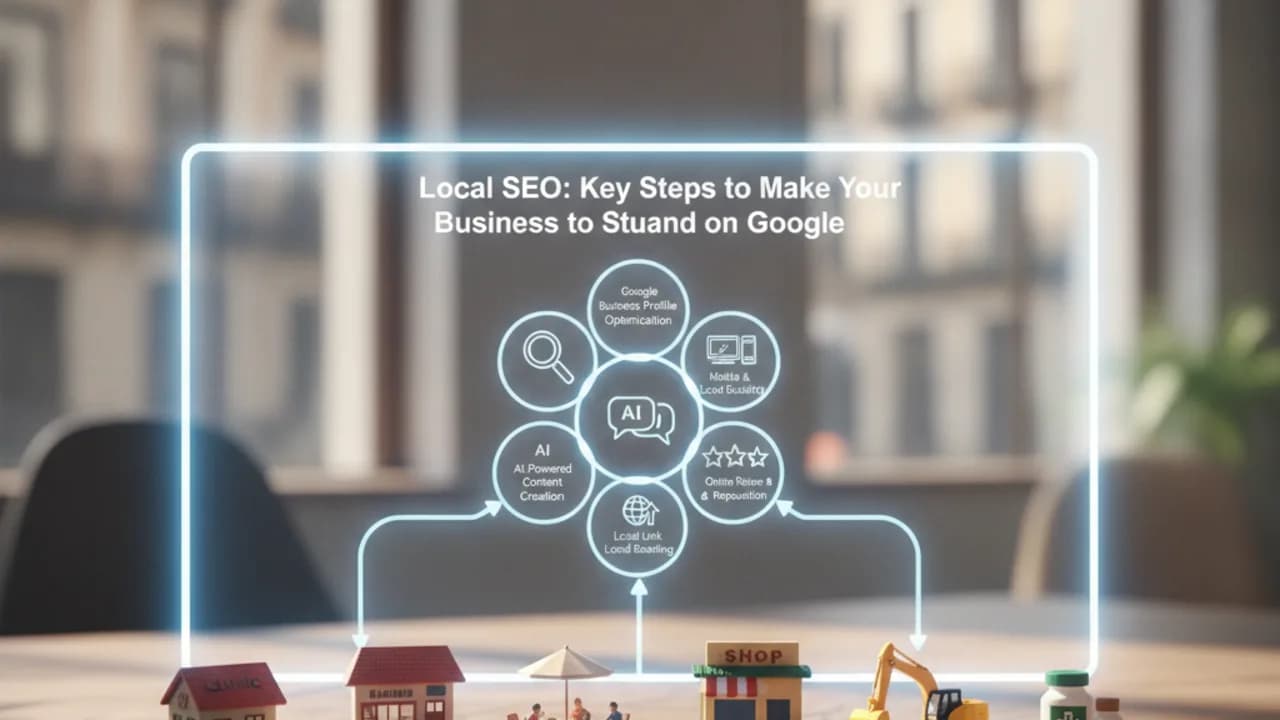
Local SEO: Key Steps to Make Your Business Stand Out on Google
Why doesn't your business appear when someone searches nearby?
Local SEO is the set of actions that determine whether your business appears—or not—when someone in your city searches for what you offer on Google. It's not a matter of luck or advertising budget; it's the result of having the right information in the right place. If you're a dentist, have a pharmacy, or run a restaurant, this article shows you exactly what to do so that your potential customers find you before your competition. At RankCoworker, we help businesses like yours gain online visibility without the need for technical knowledge.
I remember when we started with our little café in the center. At first, no one knew we were there. We worked hard to optimize our Google profile, added authentic photos, and little by little, customers began to arrive. It was amazing to see how something so simple could make a big difference in our local presence.
Step 1: Create or Claim Your Google Business Profile
Before any other action, you need to control the listing that Google shows about your business. According to Google, the Business Profile is a free tool that allows you to manage how your business appears in Search and Maps, publish updates, showcase products and services, and connect with customers [2]. Creating that profile and appearing on Google is free of charge [3].
The process begins at business.google.com/add. From there, you can add your business or claim one that already exists. Once verification is complete, you can control all the information that Google displays about your company [6]. If your business travels to customers—like a remodeling company, for example—you can define cities, postal codes, or service areas instead of a fixed address [5].
What information you must fill out
Google recommends representing the real name of the business, maintaining an accurate address or service area, using a single profile per business, and choosing the minimum number of specific categories necessary to describe the main activity [1]. Many businesses lose positions because they have duplicate data or generic categories that do not accurately describe their activity.
Pay special attention to these fields:
- Real business name: without artificially added keywords.
- Main category: as specific as possible (e.g., "Dental clinic" instead of "Clinic").
- Description: include the main services and the location where you operate.
- Opening hours: keeping it updated prevents customers from arriving when the store is closed.
- Photographs: the interior, exterior, and team generate more trust than a stock image.
- Services and products: the more detailed, the more searches you can cover.
In my experience as a sports store owner, improving our Google profile changed how customers viewed us. We used to receive few visits, but by adding authentic photos and a detailed description, more people started coming interested in what we offered locally.
Step 2: Understand how Google decides who to show first
Google indicates that local results depend mainly on three factors: relevance, distance, and prominence [4]. Understanding each one helps you know where to focus your efforts.
| Factor | What it means | How to work on it |
|---|---|---|
| Relevance | How well your profile matches what the user is searching for | Complete all profile fields and use the correct categories |
| Distance | Proximity between the business and the person making the search | Clearly define the address or service area |
| Prominence | Online reputation: reviews, mentions, and web content | Get reviews, publish content, and gain local mentions |
According to an analysis of 7,718 businesses published by Search Atlas in 2025, proximity explained 55.2% of the variation in local ranking, followed by review volume at 19.2% [8]. This means that if a customer searches from the other side of the city, having a perfect profile is not always enough; but if they are nearby, the difference between appearing and not appearing is marked by reviews and the quality of your information.
Relevance is also worked on outside the profile
Local SEO relates product or service keywords to a geographic location [7]. This means that a website with relevant content—such as articles about the services you offer in your city—reinforces your position in local results. A blog that attracts customers without knowing about SEO is one of the most sustainable ways to build that relevance month after month.
Step 3: Manage your reviews and online reputation
Reviews are the second most important factor in local ranking according to the same research from Search Atlas [8]. And it's not just about accumulating stars: the quality of the text, the frequency with which they arrive, and how the business responds have a direct impact on user trust.
These are the concrete steps to manage the online reputation of your local business:
- Actively ask for reviews: after each service or purchase, do it directly and simply (WhatsApp message, physical card with QR, automated email).
- Respond to all reviews: both positive and negative. A professional response to a complaint generates more trust than ignoring it.
- Do not buy fake reviews: Google detects them and can suspend your profile.
- Use reviews as feedback: if three customers mention the same problem, it's a sign to improve the service.
Online reputation affects restaurants, stores, pharmacies, and clinics equally. A restaurant with 80 recent reviews and a rating of 4.5 stars is much more likely to appear on the local map than one with 15 old reviews and an average of 3.8, even if they are at the same distance from the user.
Step 4: Publish content that answers your customers' questions
Google rewards businesses that demonstrate activity and knowledge. Publishing articles on your website about the services you offer, the problems you solve, or the most frequent questions from your customers builds the relevance we talked about earlier. For a dental clinic, an article on "when orthodontics is needed" can attract exactly the type of patient looking for that treatment in your city.
Content also starts to carry weight in search engines with artificial intelligence systems like ChatGPT, Perplexity, or Google's own AI Overviews. These systems cite businesses and websites when the published content clearly answers a specific query. Appearing in ChatGPT and AI search engines does not require a different strategy: it requires the same foundation of useful content, but published consistently.
The real obstacle is not knowing what to write, but having the time and consistency to do it. That's why many local businesses opt for automated systems that publish monthly articles tailored to their sector and area, without the business owner needing to get involved in writing.
Step 5: How to choose a local SEO service (and what to ask before hiring)
If you decide to delegate the online visibility of your business, it's essential to know what you're hiring. The market is full of vague promises and hard-to-measure results. Here are the questions you should ask before signing anything:
- Does the service include optimizing my Google Business Profile, or just the website?
- How are the keywords adapted to my sector and specific city?
- Will I receive visibility reports with real data, or just screenshots?
- Is the content they publish designed to attract customers, or is it generic content?
- How often are new articles or updates published?
- What happens if I want to cancel? Is there a commitment?
An honest service answers all these questions clearly and shows you real examples of businesses similar to yours. At RankCoworker, we offer monthly articles tailored to your business's keywords and area, scheduled automatic publication, AI-generated texts and images, editorial oversight, plus visibility reports so you know exactly what is working. No commitment contracts and no technical jargon.
I have tried several SEO services over the years. Some promise a lot and do little. What really works is the one that provides measurable results and maintains clear communication with you. Transparency is vital in this type of service.
Step 6: Maintain consistency of your information across the web
One of the most common mistakes in local SEO is having different data on different sites. If your address on Google says "Calle Mayor, 12" and on your website it appears as "C/ Mayor 12-bajo", for a human it’s the same, but for algorithms, it can create uncertainty about which information is correct.
Check that the name, address, and phone number of your business are identical in:
- Your Google Business Profile
- Your website (especially in the footer or on the contact page)
- Active social media
- Local or sector directories where you are registered
This consistency is called NAP (Name, Address, Phone) and is one of the signals that Google uses to confirm that your business information is reliable.
Frequently Asked Questions about Local SEO
How long does local SEO take to work?
The first changes are usually seen between 4 and 12 weeks, depending on the competition in your sector and city. Factors like reviews and content publication generate results progressively, not overnight. Consistency is the factor that most differentiates businesses that climb positions from those that stagnate.
Do I need a website to improve my local SEO?
It's not essential to appear on Google Maps, but it does make a significant difference in the relevance and prominence of your profile. A business with a well-optimized website combines local map visibility with organic search results, multiplying opportunities to attract customers.
Can I manage my Google Business Profile myself?
Yes, the profile is completely manageable from a mobile or computer without technical knowledge. The most demanding part is not the initial setup, but keeping it active: responding to reviews, publishing updates, and updating the information whenever something changes in the business.
Does local SEO work for businesses that don't have a physical store?
Yes. If your business travels to customers—installers, plumbers, catering companies, home therapists—you can define a service area in your profile instead of a fixed address. Google will show your business to users within that area when they search for what you offer.
Conclusion
Local SEO is not a one-time trick: it is the result of maintaining the correct information, consistently obtaining reviews, and publishing useful content month after month. Starting does not require a large budget or technical knowledge; it requires taking each step in the right order and maintaining consistency. If you prefer someone to do it for you while you focus on your business, RankCoworker publishes monthly articles tailored to your sector and city, with reports so you always know how your visibility is evolving.
References
- [REF-1] Google — Guidelines for properly displaying your business on Google. https://support.google.com/business/answer/3038177?hl=es
- [REF-2] Google — Help with questions and answers - Google Business Profile. https://www.google.com/intl/es_es/business/faq/
- [REF-3] Google — Get visible on Google - Google Business Profile. https://business.google.com/es/business-profile/
- [REF-4] Google — Tips to improve local ranking on Google. https://support.google.com/business/answer/7091?hl=en
- [REF-5] Google — Edit your Business Profile. https://support.google.com/business/answer/3039617?hl=es-419
- [REF-6] Google — How to add or claim your Business Profile. https://support.google.com/business/answer/2911778?hl=es-419
- [REF-7] Vitoria-Gasteiz City Council — Google Business Profile Material - October 2023. https://www.vitoria-gasteiz.org/docs/wb021/contenidosEstaticos/adjuntos/es/98/37/99837.pdf
- [REF-8] Search Atlas — Local SEO ranking factors by sector: machine learning and analysis of 7,718 businesses. https://searchatlas.com/blog/local-seo-ranking-factors-by-industry/
Related articles
More content you might like.