Google Pharmacy: A Guide to Attracting More Customers from Search Engines
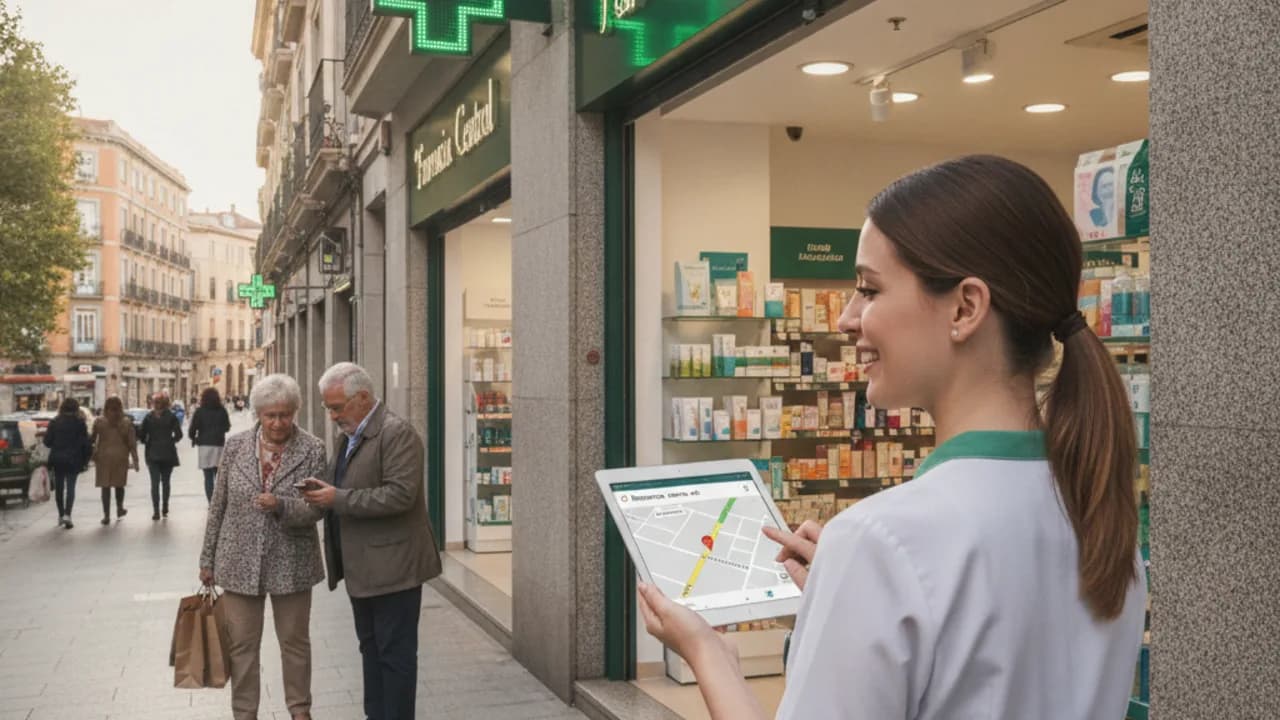
Google Pharmacy: Guide to Attracting More Customers from Search Engines
Appearing when someone searches for Google pharmacy near their home can make the difference between them walking through your door or going to the one next door. Many pharmacists know that their customers search online before going out, but they are not sure where to start or how much time it will take. This guide explains, step by step, what to do so that your pharmacy appears on Google and in AI search engines when someone in your area needs what you offer. If you want to do it without dedicating hours each week, tools like those from RankCoworker, the automated blog for local businesses, are designed exactly for that.
I remember when a customer told me they found our pharmacy thanks to a Google search. It was a revealing moment that highlighted the importance of being present online.
Why Google is the Gateway for Your Customers
When someone has a fever at ten o'clock at night or is looking for a specific cream, the first thing they do is open their phone and type in Google. Your pharmacy may be two hundred meters away, but if it doesn't appear in that search, it doesn't exist for that customer. Local visibility is no longer optional: it is the difference between filling or not filling the cash register.
According to data published by La Vanguardia (2014), 75% of the traffic to the analyzed pharmacies came from search engines, compared to an average of 28% for e-commerce in general [5]. That data, although it is years old, reflects a reality that has not changed: search engines are the most powerful channel for attracting customers to a pharmacy.
The problem is that most pharmacies still do not take advantage of this channel. Daniel Garzón, Technology Director of Evolufarma, pointed out in the 2016 study that nearly eight out of ten Spanish pharmacies did not have a presence on Google, despite the growing importance of local searches [3]. That gap remains a real opportunity for those who decide to act.
Google Business Profile: The First Mandatory Step
The Google Business Profile (formerly Google My Business) is the listing that appears on the map and in the side panel when someone searches for your pharmacy or pharmacies nearby. It is free, and not having it optimized is the most common and costly mistake made by local businesses.
From the panel itself, you can check which keywords activate your listing, how many people have asked for directions, how many have called directly, and how many have visited your website [1]. With that data, you know exactly what is working and what needs improvement. Setting it up properly takes an afternoon; leaving it poorly set up costs months of lost customers.
The minimum your listing should have to start performing:
- Exact name of the pharmacy, without artificial keywords
- Complete and verified address and phone number
- Updated hours, including holidays and on-call hours
- Photos of the premises: facade, interior, team
- Main category: Pharmacy, and secondary categories if applicable
- Brief description with the neighborhood or area and main services
- Link to your website or, if you don't have one, to your Google profile
Recently, a colleague in the neighborhood optimized his Google profile and within weeks noticed an increase in visits. It was inspiring to see how a small effort could have such a big impact.
Local SEO for Pharmacies: What to Do on Your Website and in Your Content
Having a website is not enough if no one finds it. According to the study collected by Teva Pharmacy (2016), only 0.2% of pharmacy websites were optimized for SEO [4]. This means that if you do even the basics well, you are already ahead of almost all your local competitors.
Optimizing for local SEO does not require being a programmer. It requires being organized: choosing the keywords that your customers use, including them in the texts and titles of your website, and publishing content that answers their questions. That content is what Google rewards with visibility.
Keywords that Work for a Local Pharmacy
Your customers' searches are very specific. They do not search for "pharmacy" alone: they search for "pharmacy open now in Getafe" or "where to buy a digital thermometer near me." Those long-tail searches have less competition and higher purchase intent. They bring you customers who already have their wallets in hand.
Some keyword ideas to work on your website:
- Pharmacy + name of your neighborhood or municipality
- On-call pharmacy + your area
- Buy [specific product] + your city
- Pharmacy with [homeopathy, orthopedics, dermocosmetics...] service
- Pharmacy hours + neighborhood name
A Blog that Attracts Customers Without Knowing SEO
Regular content is the engine of long-term SEO. When you publish useful articles —how to choose an antihistamine, what to do for a sunburn, what vitamins to take in winter— Google understands that your website is relevant and shows it earlier. The study on pharmaceutical e-commerce published in Dialnet (2015) found that blogs were used by 21.69% of the analyzed online pharmacies [6]. It is a low percentage, confirming that those who do it already have an advantage.
It is not necessary to write every week. A well-focused monthly article, with the right keywords and published consistently, does more than ten poorly planned articles. The real challenge is not the content itself: it is the regularity and technical optimization.
Reviews and Online Reputation: The Most Influential Factor in Decision Making
When someone chooses between two pharmacies on Google Maps, they look at two things: distance and reviews. A pharmacy with 4.7 stars and eighty reviews conveys trust even if it is a bit farther away. One with twenty reviews and many unanswered generates doubts.
Managing your online reputation does not mean manipulating opinions. It means asking for reviews from your satisfied customers, responding to all ratings —positive and negative— politely and quickly, and publicly resolving any issues that arise. Google values active listings with recent activity.
| Factor | Impact on Ranking | Implementation Difficulty |
|---|---|---|
| Complete and Verified Business Profile | High | Low |
| Positive and Recent Reviews | High | Medium |
| Website Optimized with Local Keywords | High | Medium |
| Blog with Regular Content | Medium-High | Medium-High without automation |
| Updated Photos in the Listing | Medium | Low |
| Mentions in Local Directories | Medium | Low |
A simple trick: when you finish a consultation and the customer is satisfied, show them the QR code of your Google profile and ask them to leave a review. Most will do it if you make it easy for them.
Appearing in ChatGPT and AI Search Engines
AI search engines —ChatGPT, Perplexity, Google AI Overviews— are changing how people find local businesses. When someone asks "what pharmacy is open on Sunday in my area?", the AI responds by citing sources. If your website has clear, updated, and well-structured content, you have a better chance of being one of those sources.
The key is to publish content that answers specific questions directly. Blog articles written in a question-and-answer format work best in these new environments. It is not magic: it is having text that the AI can read and cite with confidence.
How to Choose a Digital Visibility Service for Your Pharmacy
If you do not have time to manage your blog, update keywords, and publish content each month, it makes sense to delegate that part. But before hiring any service, it is advisable to know what to ask.
These are the key questions you should ask before committing to any local digital marketing provider:
- Is the content tailored to my type of business and my geographical area?
- Do they choose the keywords based on actual searches from my customers?
- Do they publish automatically and on schedule, or do I need to intervene each time?
- Do I receive visibility reports to know if it works?
- Do they also generate images, or just text?
- Is there a minimum commitment, or can I pause if I need to?
A service like RankCoworker, which publishes monthly articles with tailored keywords for local businesses, covers exactly these points: content tailored to your pharmacy, scheduled automatic publishing, texts and images generated with AI, and visibility reports to track progress. It is an option designed for businesses that want to grow on Google without becoming marketing experts.
What you should avoid are services that promise immediate results, that do not specify the keywords they will work on, or that generate generic content without mentioning your city or your specialty. Local SEO works when the content is relevant to your specific community.
From my personal experience, a gradual and consistent approach has always proven more beneficial than seeking quick and miraculous solutions. That patience is key in the digital realm.
Frequently Asked Questions about Pharmacy and Google
How long does it take to see results on Google with a pharmacy?
It depends on the competition in your area and the regularity with which you publish content. In local markets with little digital optimization, it is common to see improvements in visibility between three and six months after optimizing the Business Profile and publishing monthly content. The key is consistency, not speed.
Do I need a website to appear on Google Maps?
It is not mandatory to have a website to appear on Google Maps: the Google Business Profile works independently and allows you to be found even if you do not have your own page. However, having a well-optimized website significantly improves your position both on Maps and in organic search results.
What type of content interests pharmacy customers?
Customers are looking for answers to specific problems: symptoms, remedies, product comparisons, seasonal advice, on-call hours. Articles that clearly answer those questions attract qualified traffic, people who already have a need and are one step away from visiting you.
Do Google reviews affect my pharmacy's ranking?
Yes, reviews are one of the factors that Google uses to rank local results. A higher number of recent and positive reviews, combined with responses from the owner, signals to Google that the business is active and trustworthy. Managing reviews well is as important as having a complete listing.
Conclusion
Appearing on Google when someone searches for a pharmacy nearby is not luck: it is the result of having the Business Profile well configured, publishing useful content regularly, and actively managing reviews. Each of those steps is within reach of any pharmacist, with or without technical knowledge. If you prefer to focus on your patients and let the content work for itself, RankCoworker helps you gain visibility on Google with automated monthly articles for your pharmacy. The best time to start was six months ago; the second best time is now.
References
- [REF-1] Help from Google Business Profile — Understanding the performance and statistics of your Business Profile. https://support.google.com/business/answer/9918094?hl=es-419=
- [REF-2] Google — Get visible on Google - Business Profile on Google. https://business.google.com/es/business-profile/
- [REF-3] Diariofarma — Can a pharmacy increase its average ticket with its online presence?. https://diariofarma.com/2016/05/26/puede-aumentar-el-ticket-medio-de-una-farmacia-su-presencia-online
- [REF-4] Teva Pharmacy — Gaining visibility for the pharmacy and positioning on the web. https://www.tevaFARMACIA.es/academia/comunicacion/ganar-visibilidad-de-la-farmacia-y-posicionamiento-en-la-red
- [REF-5] La Vanguardia — E-commerce: a pending subject for pharmacies. https://www.lavanguardia.com/tecnologia/internet/20141021/54418125418/comercio-electronico-asignatura-pendiente-farmacias.html
- [REF-6] Dialnet — E-commerce of Spanish online pharmacies. https://dialnet.unirioja.es/descarga/articulo/5200515.pdf
- [REF-7] IPMARK — Digital marketing in the pharmaceutical sector. https://ipmark.com/marketing-digital-del-sector-farmaceutico/
Related articles
More content you might like.